Tuesday, May 10, 2011

How Should Christians Respond to the Death of Osama bin Laden?

Photo by NYCMarines

The Christian blogosphere has been rife with articles about the proper Christian response to the killing of Osama Bin Laden. Many say that we should never celebrate the death of another human being, but rather, be sorrowful at the death of a man created in the image of God. But here’s a question I’ve yet to hear asked:

“How should Christians respond to the salvation of Osama bin Laden?”

You heard me correctly. If Osama Bid Laden repented and turned to the Lord in the hours or minutes before his death, then he’s in paradise. Just like the thief hanging on the cross next to Jesus.

Would you celebrate?

Of course, I understand the concept of heavenly rewards and those that will “suffer loss” (1 Corinthians 3:15). But what about the fact that Bid Laden could even be in heaven (the real one, not the Muslim one with all the virgins)... while many of the people he killed – good, honest, hard-working mothers and fathers, sons and daughters, brothers and sisters – are not? Where’s the justice in that?

We think it’s wonderful that we’re washed in the blood of Jesus, that our past is completely forgiven, that our sins are atoned for. But in the back of our minds, we harbor this thought: that our sins are not so bad compared to the next guy’s. Even the worst alcoholic, drug addicted sinner who abused and abandoned his family, robbed convenience stores to support his habit, did hard jail time, then repented and turned to the Lord can look at Osama bin Laden and say, “My sin wasn’t as bad as his.”

But here’s the fly in the ointment:

All of us also lived among them at one time, gratifying the cravings of our sinful nature and following its desires and thoughts. Like the rest, we were by nature objects of wrath. (Ephesians 2:3, Italics Mine)

You see, it’s our nature, not our behavior, which condemns us. But so often we haul out the scales of justice, heap our sins on one side and the sins of another person on the opposite side ... and feel quite justified when it tips to our favor. But on God’s scale, our sin weighs in the same as Bin Laden’s. If you think that’s harsh, consider the words of Jesus:

You’re familiar with the command to the ancients, “Do not murder.” I’m telling you that anyone who is so much as angry with a brother or sister is guilty of murder. Carelessly call a brother “idiot!” and you just might find yourself hauled into court. Thoughtlessly yell “stupid!” at a sister and you are on the brink of hellfire. (Matthew 5:21-22, The Message)

Or Romans 3:9-19:

There is no one righteous, not even one;
   there is no one who understands,
   no one who seeks God.
All have turned away,
   they have together become worthless;
   there is no one who does good,
   not even one.
Their throats are open graves;
   their tongues practice deceit.
The poison of vipers is on their lips.
Their mouths are full of cursing and bitterness.
Their feet are swift to shed blood;
   ruin and misery mark their ways,
   and the way of peace they do not know.
    There is no fear of God before their eyes.

Now we know that whatever the law says, it says to those who are under the law, so that every mouth may be silenced and the whole world held accountable to God. Therefore no one will be declared righteous in his sight by observing the law; rather, through the law we become conscious of sin.

Isn’t that the whole point of the Gospel?

“But what about the people Bid Laden killed? Doesn’t he have to answer to them?”

King David wrote Psalm 51 after his adultery with Bathsheba. You may recall how he’d gotten her pregnant while her husband was off fighting in David’s army. Then David conspired to cover it up by bringing her husband back for a conjugal visit. When Uriah refused, David arranged for him to be placed on the front lines of battle where he would be killed.

Inarguably, David sinned against many people, not the least being Uriah. Yet in Psalm 51:4 he tells the Lord, “Against you, you only, have I sinned and done what is evil in your sight...” In our self-conscious, self-centeredness, we often overlook the fact that the person who has sinned against us has really sinned against God – and we ought to let him deal with it.

Earlier I asked where’s the justice if Bid Laden could be in heaven while many of the people he killed are not? Here’s where the justice is... at the cross, where Jesus Christ was crucified and died, taking on the sins of the world – including Osama bin Laden’s. I’ll leave you with Psalm 130:3-4 to consider:

If you, O LORD, kept a record of sins,
   O Lord, who could stand?
But with you there is forgiveness;
   therefore you are feared.

Thursday, March 31, 2011

“Is this all?”

Photo by Mysi

Each suburban wife struggles with it alone. As she made the beds, shopped for groceries, matched slipcover material, ate peanut butter sandwiches with her children, chauffeured Cub Scouts and Brownies, lay beside her husband at night — she was afraid to ask even of herself the silent question — “Is this all?”

— Betty Friedan (The Feminine Mystique)

Since then, millions of women have entered the workforce. I wonder if they’ve discovered what millions of men have known for centuries:

Each working husband struggles with this alone. As he made his sales quota, shopped for office supplies, matched the new brochure to the corporate colors, ate lunch with his co-workers, chauffeured Clients and VPs, sits at his desk at day’s end — he was afraid to ask even of himself the silent question — “Is this all?”

— John Tabita (The Masculine Mystique)*

* Not a real book

Wednesday, March 2, 2011

The Other Psalm 91

“Welcome Home.” Photo by The U.S. Army

Psalm 91 is often referred to as “the Soldier’s Psalm” because of its promise of protection. But it’s not the only one to do so:

Psalm 121

I lift up my eyes to the hills—
  where does my help come from?
My help comes from the LORD,
  the Maker of heaven and earth.

He will not let your foot slip—
  he who watches over you will not slumber;
indeed, he who watches over Israel
  will neither slumber nor sleep.

The LORD watches over you—
  the LORD is your shade at your right hand;
the sun will not harm you by day,
  nor the moon by night.

The LORD will keep you from all harm—
  he will watch over your life;
the LORD will watch over your coming and going
  both now and forevermore.

Sunday, February 13, 2011

What Will It Take For You To Finally Be Free Of Sin's Power?

Photo by seanmcgrath

A few months back, I wrote a blog post on Turning off Sin’s Power. This week on Facebook, my former pastor posted the following:

Pop Quiz: What will have to happen in order for you to finally be free from the power of sin?

On Sunday, I read the following in a book I happen to pick up:

Did you ever stop to think about it: Salvation belongs to the sinner. Jesus already bought the salvation of the worst sinner, just as He did for us. That’s the reason He told us to go tell the Good News; go tell sinners they’re reconciled to God.

It goes on to say that if the sinner doesn’t know this, it won’t do him any good. It makes sense – salvation is a free gift that I receive by believing. If I either don’t know or don’t believe, it’s of no avail.

The salvation the author is talking about here is freedom from the penalty of sin. That’s for the sinner. But freedom from the power of sin... that’s for the believer. Romans 6:6-7 says:

For we know that our old self was crucified with him so that the body ruled by sin might be done away with, that we should no longer be slaves to sin – because anyone who has died has been set free from sin.
If I received freedom from the penalty of my sin by believing verses like Colossians 2:13-14 and Romans 10:9, then it stands to reason that I won’t really receive freedom from the power of sin unless I believe verses like Romans 6:6-7 as well. As Romans 6:11says, “...consider yourselves dead to sin and alive to God in Christ Jesus.”

So it turns out that getting free from sin’s power also requires belief, or faith. You have to believe what the Word says. Go figure.

Monday, January 24, 2011

Seeing God’s Face

Photo by spoon

I had an interesting thought the other day on the way to work, something I had never really thought about before: Will we see God’s face when we’re in heaven?

You see, the night before, my youngest son had been having trouble sleeping because of bad dreams. So I sat with him at bedtime and read Scripture to him. I found myself reading out of the Old Testament… the sixth chapter of Isaiah where he has a vision of the Lord seated on his throne… Exodus 33 when Moses is on the mountaintop speaking with God.

I wanted Josh to see the bigness of God, so I read the part where Moses tells the Lord, “Now show me your glory,” to which God replies:

“I will cause all my goodness to pass in front of you, and I will proclaim my name, the LORD, in your presence. I will have mercy on whom I will have mercy, and I will have compassion on whom I will have compassion. But,” he said, “you cannot see my face, for no one may see me and live.”

The narrative goes on to say that the Lord placed Moses in a cleft in the rock and covered him with his hand until his glory had passed by, then removed his hand so that Moses would see his back because “my face must not be seen.”

So if seeing God’s face spells certain death, will heaven be like Exodus 20:18, with the Lord on a smoke-filled mountaintop and we trembling at a distance, telling Jesus, “Speak to us yourself and we will listen. But do not have God speak to us or we will die.”?

But everything I’ve talked about so far is Old Covenant. Hebrews 7 and 8 says we have a better covenant founded on better promises. One way the New Covenant is superior to the Old is that our very nature has changed. You see, under the Old Covenant, sins were merely covered, not atoned for. That’s why the priest had to continually offer sacrifices. (See Hebrews 7:27.) But under the New Covenant, Jesus sacrificed himself “once for all.” In doing so, he took on the penalty of our sin upon himself and exchanged our unrighteousness for his righteousness:

God made him who had no sin to be sin for us, so that in him we might become the righteousness of God. (2 Cor 5:21)

That’s why David’s psalms continually exhort us to “seek his face.” I believe David foresaw the day when we, as spirit-filled, born again believers, would be able to see his face and yet live… and also to the ultimate Day when “we shall see face to face:

Now we see but a poor reflection as in a mirror; then we shall see face to face. Now I know in part; then I shall know fully, even as I am fully known. (1 Cor 13:12)

Monday, January 17, 2011

The Words of Martin Luther King, Jr.


We sometime forget that, beside leading the Civil Rights movement, Martin Luther King, Jr. was also a man of God.

So I say to you, seek God and discover Him and make Him a power in your life. Without Him, all of our efforts turn to ashes and our sunrises into darkest nights. Without Him, life is a meaningless drama with the decisive scenes missing.

But with Him, we are able to rise from the fatigue of despair to the buoyancy of hope. With Him, we are able to rise from the midnight of desperation to the daybreak of joy. St. Augustine was right — we were made for God and we will be restless until we find rest in Him.

Love yourself, if that means rational, healthy, and moral self-interest. You are commanded to do that. That is the length of life. Love your neighbor as you love yourself. You are commanded to do that. That is the length of breadth of life.

But never forget that there is a first and even greater commandment,“Love the Lord your God with all thy heart and all thy sol and all thy mind.” This is the height of life. And when you do this you live the complete life.

- Martin Luther King, Jr.

Friday, December 24, 2010

A Social Network Christmas

Touching and funny. The Christmas story told via Joseph's Facebook account...

Friday, December 17, 2010

Righteous by Nature


I was reading Romans 2 the other day and verse 28-29 jumped out at me:

I have come to the conclusion that a true Jew is not the man who is merely a Jew outwardly, and a real circumcision is not just a matter of the body. The true Jew is one who belongs to God in heart, a man whose circumcision is not just an outward physical affair but is a God-made sign upon the heart and soul, and results in a life lived not for the approval of man, but for the approval of God. (Rom 2:28-29, J B Phillips’ New Testament in Modern English)

Circumcision was an outward sign, but Paul is saying here that the true Jew is one whose heart has been inwardly circumcised, in the putting off of the sinful nature (see Col 2:11-12). It struck me how we try to circumcise ourselves outwardly, by changing our behavior to look more “Christian,” and we encourage others to do the same. Here’s an example:

When my wife and I were still dating, we attended a Harvest Crusade in Anaheim, CA. At that time, my wife smoked, and as we drove out of the stadium parking lot, windows down, someone shouted, “Jesus is Lord!” to which my wife shouted back, “Amen!” Without missing a beat, the person yelled back, “Then why are you smoking?”

You see, it’s much easier to circumcise ourselves outwardly… stop smoking, quit swearing, dress more modestly. All those things are well and good, but in Mathew 23:23, Jesus called the Pharisees “hypocrites” for focusing exclusively on external behavior:

You give a tenth of your spices—mint, dill and cummin. But you have neglected the more important matters of the law—justice, mercy and faithfulness. You should have practiced the latter, without neglecting the former.

Here’s where we get it wrong. We think sin is about behavior. It’s not. Before you were saved, you were not hell-bound because of your behavior. You were hell-bound because of your nature:

All of us also lived among them at one time, gratifying the cravings of our sinful nature and following its desires and thoughts. Like the rest, we were by nature objects of wrath. (Eph 2:3)

We were by nature objects of wrath… not by behavior. Do you see the difference?

If you don’t grab a hold of this, then you’ll fall into the trap of thinking that, because you sin as a Christian, then you are still a sinner. But that’s not Biblically true. In my last post, I proved in the Scriptures that we are not sinners or fallen creatures, but a new creation (see 2 Cor 5:17 ). So in the same manner that we once were sinners by nature, we are now righteous(ers) by nature!

God made him who had no sin to be sin for us, so that in him we might become the righteousness of God. (2 Cor 5:21)

Wednesday, December 8, 2010

Fallen Creature or New Creation?


Here are a couple of Scripture verses for you to consider:

You see, at just the right time, when we were still powerless, Christ died for the ungodly. Very rarely will anyone die for a righteous person, though for a good person someone might possibly dare to die. But God demonstrates his own love for us in this: Although we are still sinners, Christ died for us. (Rom 5:6-8)

Therefore if anyone is in Christ, he is a hybrid creature; the old things have not quite passed away; but behold, some new things have come! (2 Cor 5:17)

Unless you glossed over the verses above, you probably realize that that’s not how they read… I changed a few words.

Before you start picking up stones, let me explain.

You see, despite how those verses really read, most of us think and act as if my rendition were true. And it doesn’t help when theologians and Bible scholars publish books that say as much. Case in point:

When we pray, we pray not only as saints but also as sinners, very much inclined to use prayer to advance our own selfish interests, even when we pray out of desperation. Prayer for that reason is highly complex. On the one hand, the very act of praying reminds us that we are children of God. On the other hand, that same act of praying exposes us for the fallen creatures we are. (Italics Mine)

Jerry Sittser, When God Doesn’t Answer Your Prayer (Grand Rapids: Zondervan, 2003), pp 67-68.

And:

This prayer is simple and profound: “Jesus Christ, son of God, have mercy on me, a sinner.” The most basic concerns that true prayer should address are found in this prayer: It identifies Jesus as God’s son, acknowledges that we are sinners, and asks God for mercy. (Italics Mine)

Ibid, p 105.

But is that what scripture really says about us? Are we some kind of hybrid creature — part sinner, part saint? Let’s look at the correct rendering of Romans 5:6-8 and 2 Corinthians 5:17.

Romans 5:6-8
You see, at just the right time, when we were still powerless, Christ died for the ungodly. Very rarely will anyone die for a righteous person, though for a good person someone might possibly dare to die. But God demonstrates his own love for us in this: While we were still sinners, Christ died for us.

2 Corinthians 5:17 (AMP)
Therefore if any person is [ingrafted] in Christ (the Messiah) he is a new creation (a new creature altogether); the old [previous moral and spiritual condition] has passed away. Behold, the fresh and new has come!

Romans 5:8 says that while we were still sinners, Christ died for us. “Were” is past tense! Otherwise, the verse would read like I rewrote it: “Although we are still sinners…” but it doesn’t.

Romans 5:10 goes on to say that we “were reconciled to him [God] through the death of his Son.” To reconcile is to change or exchange. According to Vine’s, it denotes “to change from one condition to another.” When you balance your checkbook and find an error, it’s your checkbook, not the bank that makes the adjustment, the change. By reconciling us, God didn’t change; he didn’t decide to accept us in spite of us being sinners. Instead, he changed us from sinners to righteous-ers — that is, the righteousness of God. He re-made us back into his own image, created in true righteousness and holiness (see Eph 4:24). If, as Romans 5:19 says, that through the obedience of Jesus we were made righteous, how then can I be both righteous and a sinner at the same time? Am I a righteous sinner?

In the Scriptures, “sinners” is never used as a description of the church. The Bible refers to the church as saints, or holy ones, but never sinners. If you identify yourself as a sinner, you are separating yourself from Christ — because Jesus, our resurrected high priest, can have nothing to do with you:

Such a high priest meets our need—one who is holy, blameless, pure, set apart from sinners… (Heb 7:26; Italics mine)

You are not a “fallen creature,” as Sittser claims — you are a new creature!

Monday, November 15, 2010

The Truth About God


Ever notice how “lie” is smack-dab in the middle of the word “believe”?

It makes a great word picture, showing us that Satan is much too clever to come at us with a boldfaced lie. Instead, he wraps some truth around the lie — like he did by quoting Scripture to Jesus to tempt him into sin.

Likewise, he comes at us by telling us the truth about our earthly nature. Or, to put it more precisely, he points out reality instead of Truth.

In 2 Corinthians 10:4-5, Paul describes thoughts as strongholds and tells us to “take captive every thought to make it obedient to Christ.”

The weapons we fight with are not the weapons of the world. On the contrary, they have divine power to demolish strongholds. We demolish arguments and every pretension that sets itself up against the knowledge of God, and we take captive every thought to make it obedient to Christ.

But every wrong thought doesn’t necessarily originate from Satan. There is also the mind of the flesh which is hostile towards God:

...for the mind of the flesh [is] death, and the mind of the Spirit — life and peace; because the mind of the flesh [is] enmity to God... (Romans 8:6-7, Young’s Literal Translation)

But whether the thought comes from devil or the flesh, the solution is still the same... take every though captive. Here’s what I mean:

I woke up one morning feeling particularly down. I had been taking care of the kids while my wife was out of town visiting her mother and I was feeling overwhelmed. I sat on the edge of the bed for a long time thinking about how I didn’t have the strength to even start my day and contemplated staying home from work.

But then I remembered a verse. Or, more precisely, I remembered a song. It was Everlasting God, by Lincoln Brewster. At the end of the song a young child reads Isaiah 40:28-29, but it was verse 29 that popped into my mind that morning:

He gives power to the weak
   and strength to the powerless.

As I spoke the words, I could feel strength return to my body. I got up, got ready for work and had a great day. But here’s the deal: I had to say these words out loud. Romans 10:17 says that faith comes by hearing, not by thinking. Would I have had the same experience if I’d sat on the bed and just thought about that verse? I doubt it.

Does it feel strange to do that, like you’re talking to yourself? David didn’t think so... he talked to “himself” regularly:

Why are you downcast, O my soul?
    Why so disturbed within me?
    Put your hope in God,
    for I will yet praise him,
    my Savior and my God.

- Psalm 42:5 (Also see Ps 42:11, 43:5)

And:

Praise the LORD, O my soul;
    all my inmost being, praise his holy name.

Praise the LORD, O my soul,
    and forget not all his benefits-

who forgives all your sins
    and heals all your diseases...

- Psalm 103:1-3 (Also see Ps 104:1,35, 146:1)

Your soul (i.e., you mind, emotions and will) must submit to either the flesh or the Spirit... there’s no middle ground. Remember, your flesh dwells within you, but you are not your flesh. So tell your flesh to shut up, tell your soul to rise up, and walk in the victory He’s promised.

Thursday, November 11, 2010

The Truth About You

This video will have a greater impact without any introduction. Please watch!

Tuesday, November 2, 2010

We’re the Apple of His Eye

Here’s an election I watched closely, for non-political reasons.

Incumbent Alan Grayson ran a vicious attack ad which twisted challenger Daniel Webster’s words at a Christian Men’s Conference completely around...


Daniel Webster won tonight with 56 percent of the vote to Grayson’s 38 percent in their central Florida district around Orlando.

“—for whoever touches you touches the apple of his eye—”

- Zechariah 2:8

Friday, October 22, 2010

Why are Christians so…?

Photo by Natalie Dee

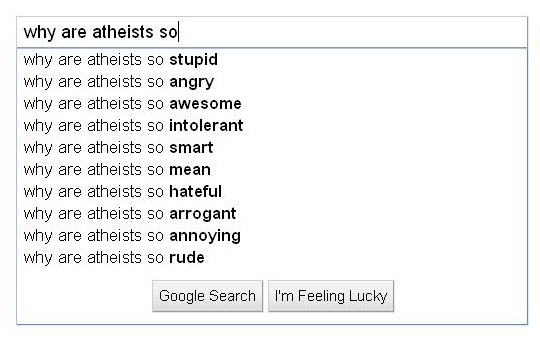
You’re probably already familiar with Google’s autosuggest feature (even if you didn’t know what it was called). That’s when you begin typing a phrase in the Google search box, and Google completes it with a number of suggestions.

Because the suggestions are based on the most common searches starting with that phrase, it can also reveal popular opinions and beliefs about a specific topic. The website Blame it on the Voices decided to see how Google’s autofill would complete phrases like:  why are christians so… and  why are muslims so… (You can see the results here.)

They even took it a step further and created a venn diagram to demonstrate what traits people perceive Christians and Muslims as having in common. And here they are...
  • Crazy
  • Hateful
  • Ignorant
  • Stupid

I decided to conduct my own experiment with why are christians so... and came up with the following:


If this merely confirms in your mind that we are being “persecuted” for what we believe, think again. When I type in why are atheists so…, I get:


So my own venn diagram shows the traits that we share with non-believers are:
  • Stupid
  • Mean
  • Hateful
  • Intolerant
  • Annoying

Are you surprised that we seem to have the exact same attitude towards those that disagree with us as non-believers have towards us? And does it bother you that we do?

Maybe Google’s algorithms can answer this: why are christians so unloving?

Saturday, October 16, 2010

The Gates of Hell


In Matthew 16, Jesus asks his disciples who the people say he is. Their responses vary: John the Baptist, Elijah, Jeremiah or one of the other prophets. Then he asks, “But who do you say that I am?” to which Peter replies: “You are the Christ, the Son of the living God.”

Then Jesus makes this statement:

Blessed are you, Simon son of Jonah, for this was not revealed to you by man, but by my Father in heaven. And I tell you that you are Peter, and on this rock I will build my church, and the gates of Hades will not overcome it. (Matthew 16:17-18, NIV)

The word translated here as overcome in the NIV is rendered in other translations as overpower and prevail. Many commentators say that this conveys the image of hell attacking the church, but that the church will prevail over everything the enemy throws at it.

But here’s my question: Since when do gates attack?

Gates are used for defense, not offense. Gates are a part of a wall and keeps attackers out of one’s fortress. If the picture here is hell attacking the church, why didn’t Jesus say the armies of hell will not overcome it?

In the NIV, the footnote to “overcome” in v.18 offers an alternative translation: not prove stronger than it. So verse 18 could well read: “...on this rock I will build my church, and the gates of Hades will not prove stronger than it.”

The Wycliffe New Testament renders this verse like so:

…upon this stone I shall build my church, and the gates of hell shall not have might, or strength, against it.

Answers In Action blog makes the point that this verse plainly says something much more dramatic than mere assurance that the church will prevail over all adverse circumstances:

The church will overcome anything the Devil may raise in defense against it. In other words, it is not merely that the church will endure, but more positively that it will take over what the Devil seeks to keep from it.

And...

So, if the gates of Hades or hell cannot prevail against the church, that must mean that the church will mount a successful offense against the powers of evil... In other words, when the gates “will not prevail,” that means that the church, in effect, knocks down the gates.

With a fresh perspective, we can go forward confidentially, knowing that we have “authority to trample on snakes and scorpions and to overcome all the power of the enemy; nothing will harm [us].” (Luke 10:19)

Tuesday, October 12, 2010

Whatever You Do, Don’t Run!

Photo by chris.merwe

Be self-controlled and alert. Your enemy the devil prowls around like a roaring lion looking for someone to devour. - 1 Peter 5:8

We think of the lion as an African species, but in ancient times, lions ranged from Greece to India and Persia. By 100 A.D., they had become extinct in Europe, but they survived in considerable numbers in the Middle East until the early 20th century. So New Testament writers like Peter would have been quite familiar with lions and their behavior.

Much has been written by modern Christian authors about how a lion will roar to scare its prey into running the other way... towards a waiting ambush of other lions. I couldn’t find any information confirming that. But I did find one reason they do roar: as a territorial display.

A lion’s roar can carry 5 miles or more. Males roar only when on their own territory. In other words, it’s a display of ownership that is only given by resident lions on their own territory.

Does that put 1 Peter 5:8 in a whole new perspective? Satan is acting like he owns the place, roaring in a lion-like territorial display. But we’re told not to give him any ground (see Ephesians 4:27).

The Safari Guide, a website that provides information to tourists visiting the bush on safari, gives this advice when encountering a lion in the wild:

One thing to remember with lions – whatever you do, don’t run! If you run away from a lion it will regard you as prey and it will chase you.

If you do get charged by a lion, you must stay still and hold your ground. This is easier said than done, but you cannot outrun a lion anyway. Lions often mock charge and break away at the last moment. They do this to show their displeasure, as an act of bravado and to ‘test’ you.

Notice how many times the word stand appears in the well-known Armor of God passage:

Put on the full armor of God so that you can take your stand against the devil’s schemes. For our struggle is not against flesh and blood, but against the rulers, against the authorities, against the powers of this dark world and against the spiritual forces of evil in the heavenly realms.

Therefore put on the full armor of God, so that when the day of evil comes, you may be able to stand your ground, and after you have done everything, to stand. Stand firm then, with the belt of truth buckled around your waist, with the breastplate of righteousness in place, and with your feet fitted with the readiness that comes from the gospel of peace.

God’s already given you all that you need for the battle, so next time the adversary confronts you, keep in mind that he’s only “like a roaring lion.” He isn’t actually one.

Thursday, October 7, 2010

The Devil is Afraid of You


When I started walking with the Lord again in the late 80’s, it felt like the devil was soooo powerful, and I cowered before him because he was always “attacking” me. But, in reality, I was just acting out my victim mentality. (I can’t do anything because the devil is always hindering me.) It was just an excuse to remain a victim.

There’s a powerful a payoff in being the victim. You always have someone else to blame when you always fail. It’s like No-Fault Insurance – it absolves you of all responsibility for what happens in your life. The payoff can also be sympathy from others. All this may feel completely “normal” if you’ve never known anything different.

But the reality is the devil’s supposed to be fleeing from us, not the other way around:

Submit yourselves, then, to God. Resist the devil, and he will flee from you. (James 4:7, NIV)

Think about the word “flee.” It’s likened to running away from something dreadful or terrible. Who flees from something they’re not afraid of?

Here’s something else to consider: the devil is more afraid of you than he was of Jesus when he tempted him in the desert.

Do you find that hard to accept? Then take another look at Luke 4:1-13. After Jesus resisted Satan’s three temptations, it says that the devil “left him until an opportune time.” Notice it doesn’t say he fled from him. Quite the opposite… it implies that he would be returning with even more temptations when the time was right.

So how can I claim that Satan is more afraid of you today than he was of Jesus on that day? Because since that day, Jesus died and rose again… and in doing so, he:

…disarmed the powers and authorities, he made a public spectacle of them, triumphing over them by the cross. (Colossians 2:15)

You see, we focus on verses that call Satan “the god of this age” (2 Corinthians 4:4) and that “the whole world is under the control of the evil one” (1 John 5:19). But as far as God is concerned, he is a defeated foe. God is not at war with Satan. Yes, he is our enemy, but the only power he has against the Christian is what we give him. He’s only “like a roaring lion…” (1 Peter 5:8). He isn’t actually one.

So the next time the devil seems so big and God so small, remember that:

…you are of God [you belong to Him] and have [already] defeated and overcome them [the agents of the antichrist], because He Who lives in you is greater (mightier) than he who is in the world. (1 John 4:4 AMP)

Saturday, October 2, 2010

“We are not unaware of his schemes...”


When I came back to the Lord in the late 1980’s, I had a couple of “conditions.” First, I didn’t want to go around telling people how Jehovah’s Witnesses and Mormons really weren’t Christians. Second, I didn’t want to know anything about the end of the world, and in particular, the devil.

Funny… God didn’t honor any of my conditions. One of the first books I read shortly thereafter was Hal Lindsay’s The Late Great Planet Earth. I also ended up teaching a class at church about the Jehovah Witnesses and their beliefs, but that’s another story.

But about the “devil” part…

Now, I’m not the type of Christian that sees a devil behind a hangnail, but at this time in my life, a series of events occurred that was hard to chalk up to coincidence. First of all I needed to move from where I was living into a condo I’d been renting out. My tenant left owing me 3 months rent and an abandoned Volkswagen bus in the garage (minus the engine, which he had apparently tried to rebuild on the living room rug… as evidenced by the large grease stain).

On top of this, going from sharing rent with a roommate to paying the entire amount myself was a financial burden in itself, but then, the company I was working for laid off our entire customer service department to relocate it at the corporate headquarters in Louisiana. Soon afterwards, the transmission on my car went out. I couldn’t get a job without a car and I couldn’t get a car without a job. I felt stuck.

But the clincher was a girl I’d been interested in. Despite having mutual feeling for one another, she had a some issues she was dealing with, so we’d decided to just be friends for the time being. (Although that didn’t diminish my feelings for her.) But soon afterwards, she approached me at a gathering we both happened to be at and began telling me how she could see herself married to me, having children with me and being happy… and I thought to myself: “Yes! See’s finally seeing what I’ve being seeing for months now!”

Then she proceeded to tell me that she had been dating “George” and that she and “George” were moving in together, and that she wanted me to know because she really did care about me.

You can imagine my drive home that night. About halfway there, I was about as low as you could get, and I begin telling God that if this is the life he had for me, that I was better off without him. I started to say that if Satan really wanted me that bad, he could just have me…

But I stopped short of saying the words. It was as if the Holy Spirit rose up in me and I suddenly shut my mouth. Even as low as I was, I recognized that it was Satan, not God, who was orchestrating all of this. It seems I wasn’t going to be able to ignore him, after all.

Incidentally, “George” turned out to be obsessive, possessive, and physically abusive. She eventually moved out and got a restraining order against him.

Thursday, September 30, 2010

Prayer and Faith (Part 5): Faith, The Title Deed


I’ve been talking about how the Greek word “assurance” in Hebrews 11:1 conveys the idea of a title deed:

Now faith is the assurance of things hoped for, the conviction of things not seen... (Heb 11:1 ESV)

In 2005, we moved from California to Ohio. Now, escrow closed on our old house on the Friday that we left town to head for Ohio. But escrow on our new house didn’t close until Monday. So from that Friday to the following Monday, we were officially homeless. Yet we didn’t fret and agonize whether we were going to have a home to live in or not. Even though we couldn’t see the new house and we didn’t possess it yet, we had “the assurance (i.e., title deed) of things hoped for, the conviction of things not seen.” (Heb 11:1)

But here’s the other thing: we never would have taken complete ownership of the house had we not showed up to sign the final papers at the escrow office on Monday morning. Remember the “blank check” analogy both both Boyd and Sittser used? Doesn’t the legal aspect of a title deed described by hypostasis more closely fit Boyd’s view than Sitter’s?

I believe it does.

Incidentally, after we signed the paperwork, they gave us the keys to the house.

I will give you the keys of the kingdom of heaven; whatever you bind on earth will be bound in heaven, and whatever you loose on earth will be loosed in heaven. -Matthew 16:18-20